Released · Reel Life Productions / Warlock Records
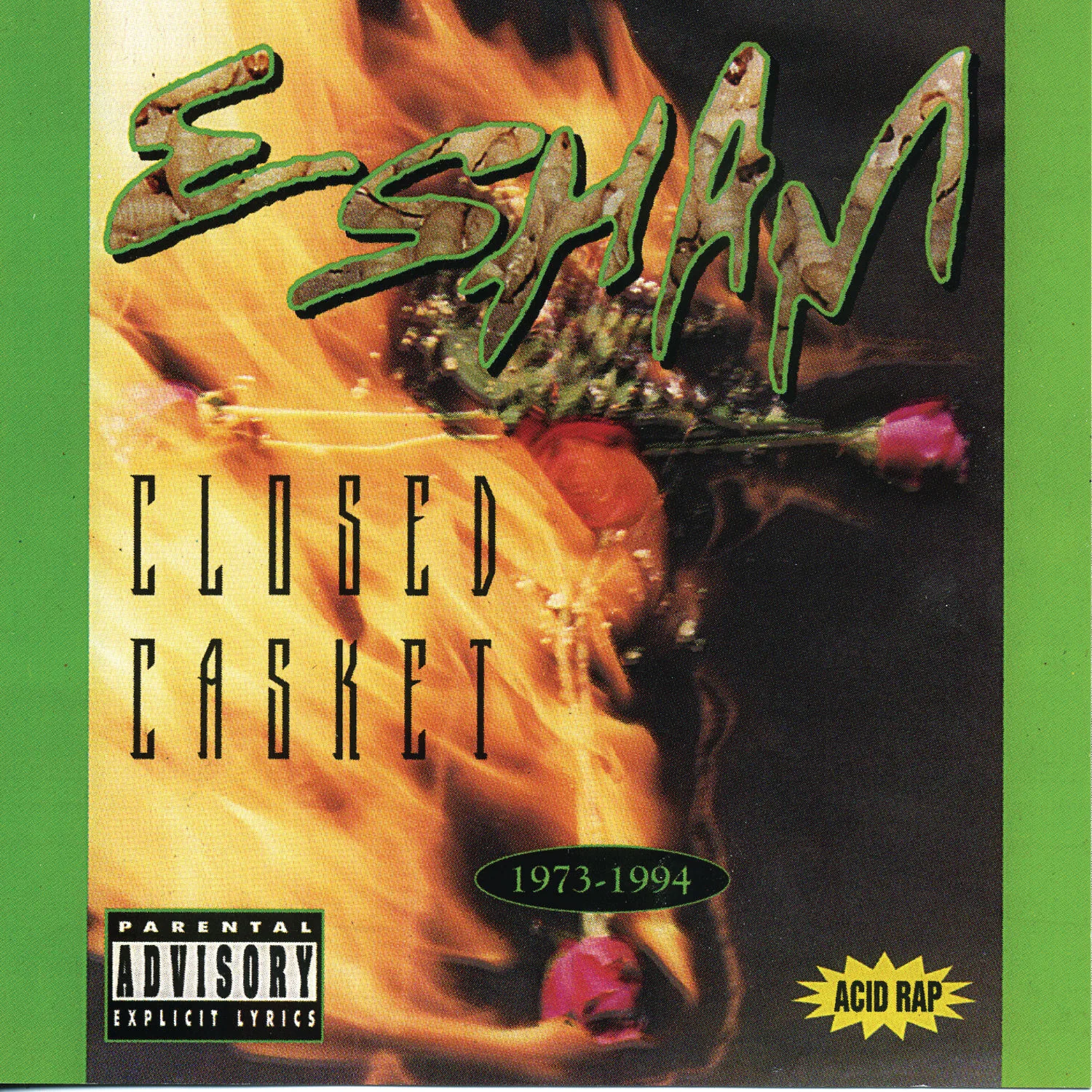
The Esham Closed Casket cover is a bouquet of roses set on fire and laid out like a cross, with 1973–1994 printed in an oval like a lifespan — and Esham says it was never his funeral.
Esham, Acid Rap, and a Detroit with no scene
Esham A. Smith started putting records out of Detroit when he was still a teenager. Boomin Words From Hell landed in 1989, when he was 16, in the depths of the city’s crack epidemic. He and his older brother, James H. Smith, ran Reel Life Productions, the independent label behind his records. He split his time growing up between Detroit and New York. He has named Alice Cooper, Iggy Pop and Aretha Franklin in the same breath.
“When I first started putting out records, there wasn’t no Detroit rap music scene,” he later told Detroit’s Metro Times. “We made the music scene.”
He called the sound Acid Rap, and sometimes Wicketshit. Asked in 2016 to explain it to a first-time listener, he reached for a drug metaphor and a kitchen one in the same answer. “We’ve taken a little bit of everything and put it into a gumbo,” he told Faygoluvers. “That’s kinda like how I would describe it, like a musical LSD gumbo.” After KKKill the Fetus in 1993 came the fourth studio album, and a title that sounded like an ending.
Closed Casket, November 1994


Reel Life Productions and Warlock Records released Closed Casket on November 22, 1994. Esham produced it, engineered it, programmed it and performed it. James H. Smith is credited as executive producer. It runs 21 tracks. It opens with “The Eulogy” and closes with the title cut. In between are “The Wicketshit Will Never Die,” “My Homie Got Shot,” “Mental Stress,” “Drive U2 Suicide,” “Flatline,” “Therapy” and “I’ll Be Glad When You Dead.” His group Natas — Mastamind and TNT — take “Chatty Ass Nigga.”
He has been clear about the frame of mind. “Closed Casket, that particular was about, I wouldn’t stay stop the Wicketshit, but almost like a pot bubbling over (so to speak) of wickedness, that I was trying to put a lid on,” he told Faygoluvers. “… They say I’m the one who created the wicket shit and opened the Hell’s doors. But in fact I was trying to close it back with this record. I was like, ‘Well this is the Wicketshit, I’m gonna close this casket on it. I hope no one ever opens this again. I hope I can seal this up!’”
The darkness, he said, came off the news in Detroit in 1994. Young people were dying in gang violence. “If you go to a funeral and someone has a closed casket, 9 times outta ten it was like something happened to their body, where their body couldn’t be viewed anymore,” he said. “So in a way making that record I was trying to prevent a lot of deaths/things of that nature. You listened to Closed Casket and this is what can happen to you/this is what can get you in a casket.”
People were already taking the art the wrong way. “By the time I was making Closed Casket, it was so heavy and people were taking art and misinterpreting the art and they were misinterpreting us as entertainers,” he said. “I was trying to say, ‘Well I’m closing the casket on this, this is just art,’ because people were coming down so heavy on us. In spite of a dark nature, I was trying to bring light to a dark subject.”
He also shut down the most obvious reading of the title track. “I never (when I was making the record Closed Casket/writing the song Closed Casket) was thinking about the closed casket as being my casket that was closed,” he said. “I pictured it always as being someone else’s casket that I was looking at. Closed Casket is not about my funeral it’s about the many funerals that have happened and the many funerals that will happen. I was trying to paint a dark picture in order to share some light on the subject.”
The Esham Closed Casket cover: real roses, real fire
The sleeve is framed in lime-green bars, like a jewel case held up to a fluorescent light. Across the top, ESHAM is written in jagged, leaning letters, filled with a mottled stone texture and outlined in hard green. CLOSED CASKET sits mid-left in thin, severe caps, two words stacked like a headstone inscription. In the lower left is the old Parental Advisory: Explicit Lyrics sticker. In the lower right, a yellow starburst stamps the genre he coined: ACID RAP.
The picture itself is a funeral that will not stay still. A bouquet of roses has been arranged into the shape of a cross and set alight. Flame eats from the left, a sheet of orange and gold rolling over the stems. One pink-red bloom still holds its shape, pointing off into the black at the right. Another hangs at the bottom, already going. In a small oval, like a date carved on a casket plate, the years read 1973–1994.
Those years look like a lifespan. Esham has said, plainly, that he never pictured the closed casket as his own. The dates still sit there, birth year to album year, daring the eye to finish the sentence he refused to write.
“It’s supposed to be like a casket on fire, but it’s not,” he told Faygoluvers. “It’s actually like some roses laid out looking like a cross.” There was no Photoshop to reach for. “Back in these days, you gotta remember Kinko’s was still around. There was no computers and all this shit.” To get fire on the sleeve, they had to make fire. “We had to set the roses on fire on top of something and then take a picture of it. So you have little roses burning with real fire, so it would look like that.”
The person holding the match was family. “My brother was doing all that. He was making that artwork.”
He tried to close the lid. He also knew better. “I attempted to close the casket, but once again the Wicketshit will never die,” he said. “It’s just the way of the world, it’s real life. Life is the Wicketshit.”
Listen: Closed Casket on Spotify