Released · Rap-A-Lot Records
Willie D found his way to Rap-A-Lot Records through a barber’s chair: he and the label’s founder, James Prince, had the same barber in Houston’s Fifth Ward.
From the Fifth Ward to Rap-A-Lot
William James Dennis was born in 1966. He told the Houston Press that the Fifth Ward, where he lived in projects like Kennedy Place, was his hood. He started rapping after hearing Run-DMC on the radio as a sophomore at Forest Brook High School. His battles in Houston’s underground clubs made his name, along with an underground hit called “Bald-Headed Hos.”
Prince, who went by Lil’ J then, signed him as a solo artist. Prince’s group the Ghetto Boys had flopped with their 1988 debut, Making Trouble, so he asked his new signing to write them something harder.
Writing for a group he didn’t want to join
Willie wrote “Let a Hoe Be a Hoe” and “Do It Like a G.O.” The members balked at the first one. “They had wives and stuff like that, so they didn’t want to be using that type language,” he told the Houston Press in 2008. “At that time I was as raw as a diamond on the bottom of the ocean.”


So Prince asked Willie to join. “I emphatically was like, ‘No – I don’t want to be in a group,’” he told Above Average Hip-Hop in 2015. Prince asked again, as a favor. “So I joined the group as a favor. I never wanted to be in the group.” Prince Johnny C and Sire Jukebox were out, and a south-side rapper then called Akshen was in. Willie met him, the future Scarface, on the first day of recording. Grip It! On That Other Level came out in March 1989.
Everything he was mad about
His solo album followed that December, credited to Willie Dee. DJ Ready Red, Doug King, Johnny C and Lil’ J produced it, Rap-A-Lot co-owner Cliff Blodget mixed it, and the opener is his own version of “Do It Like a G.O.,” recorded with Johnny C and Jukebox. He dedicated the album “to the memory of my beloved grandmother – Ernestine Smith.”
In 2012 he told The Real Hip-Hop the album “was me saying every motherfuckin’ thing I had to say that I was mad and pissed off about,” and he listed the targets: bald-headed women, welfare, the Fifth Ward, the Klan. “KKK I don’t like them motherfuckers, let me talk about that.”
Four photographs, no credits
Nothing on the packaging says who made the cover. The cassette J-card and the CD inlay list producers, an engineer, a mixer, “Lyrics by Willie Dee and Lil’J” and a long thank-you note, but no photographer or designer. None of the pressings logged on Discogs adds one, and nobody involved has publicly told the story of the shoot. What’s left is the picture.
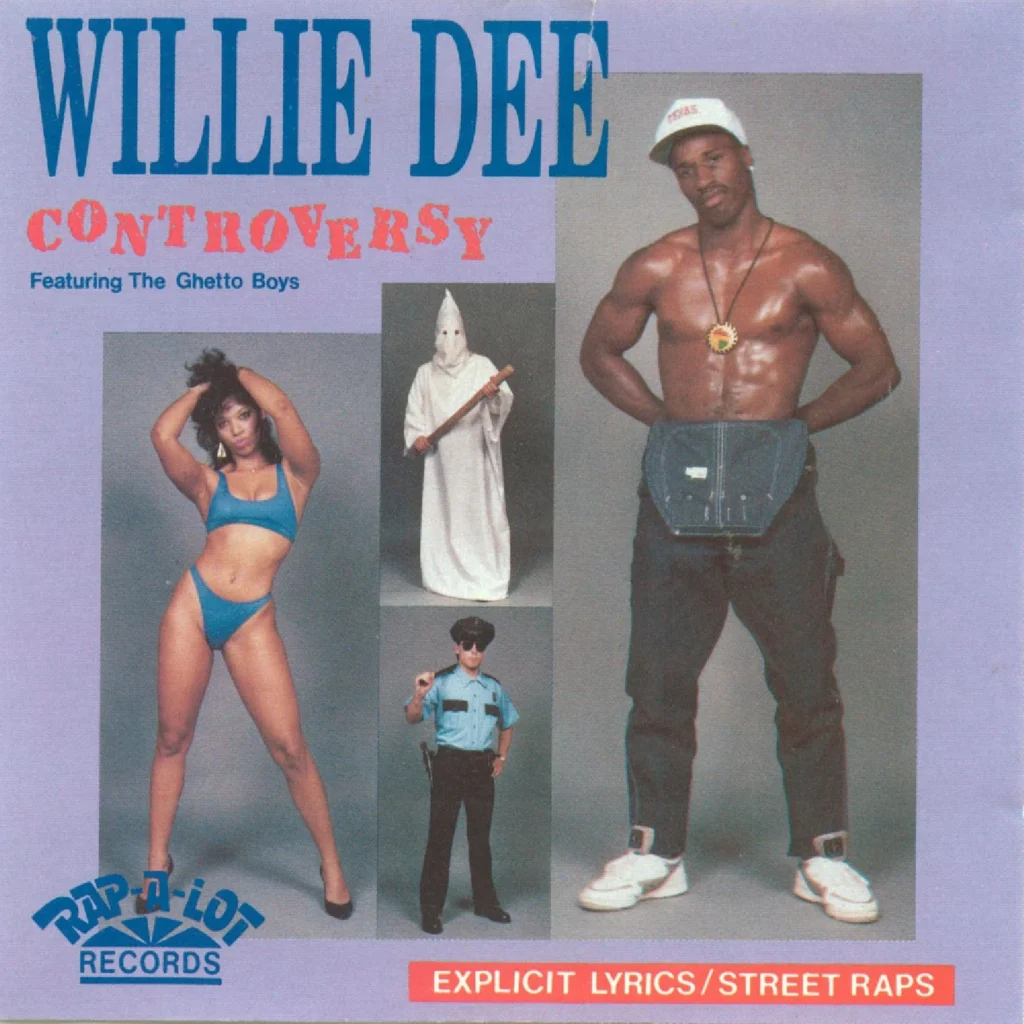
It is four separate studio portraits, each shot against the same gray backdrop and cut into panels on a lavender field. On the left is a woman in a blue bikini and high heels with her hands in her hair. Stacked in the middle are a hooded Klansman in a plain white robe, gripping a wooden club, and a police officer in a light-blue shirt and dark sunglasses. On the right, biggest of all, is Willie: shirtless and oiled, the bib of his overalls folded down at his waist, a white cap that reads TEXAS, and a medallion in the shape of Africa in red, gold and green.
The songs supply the cast. “Fuck the KKK” names David Duke: “Talking that shit in the Cajun state… Come to Texas and I’ma wait.” Duke, a former grand wizard of the Knights of the Ku Klux Klan, had taken a seat in the Louisiana House of Representatives in February 1989. The officer belongs to “Willie Dee,” which has him unable to drive “without being harassed by some bullshit police,” and to “Kick That Shit,” where both figures share one line: “the police gon’ do this to me / The KKK gon’ do that to me.” The woman has the album’s sex songs, and the long, full hair that “Bald Headed Hoes” spends four verses demanding. Willie’s own outfit answers the Klansman: Texas on his head, Africa on his chest.
The inlay moves outdoors. Willie, in the same overalls, leans on what looks like an early-’80s Cadillac with wire wheels while a woman in white sits behind him, with pine woods in the background. It plays like a line from “Willie Dee”: “Five-oh’s on my motherfucking back / ’Cause I’m a young black with a badass Cadillac.”
The lettering is tall blue capitals for WILLIE DEE and a bouncing red Controversy, with the label’s own warning in a red box: “Explicit Lyrics/Street Raps.” The RIAA’s standard black-and-white Parental Advisory logo didn’t arrive until 1990. By Priority’s 1991 reissue, the cassette carried it, and the line under the title had changed to “Featuring The Geto Boys,” the group’s new spelling.
Houston, 1989
The album landed in a tense season at home. On October 31, 1989, an off-duty Houston police officer shot and killed Ida Lee Shaw Delaney after a highway chase in his own car. Two weeks later another officer fatally shot Byron Gillum, who had been pulled over on a possible traffic violation. By November 18 the Houston Chronicle was reporting City Council members and Black community leaders calling for a citizen review board, with protesters warning of unrest. Two days before Controversy came out, the Los Angeles Times noted that Houston’s force “recently has been accused of racism, corruption and questionable shootings.” None of Willie’s songs name those cases, but a record with a cop on its cover and a verse about being pulled over “for suspicion of drugs” arrived in the middle of that argument.
How controversial was it?
No published account of a fight over this cover turned up: no store pulling it, no protest, no contemporary review. The pushback Willie described came from living rooms. On the Geto Boys’ 1990 album he rapped about “parents confiscatin’ my tapes / Sendin’ letters and shit talkin’ ’bout how they hate / The album Controversy,” then added, “I don’t give a fuck ’cause the shit still sellin’.”
The bigger fight came months later, and it came for his group. In July 1990 the plant that pressed Geffen’s CDs refused to make the Geto Boys’ Def American album, and in August Geffen refused to distribute it, saying it “glamorizes and possibly endorses violence, racism and misogyny.” The same year, a federal court in Florida ruled 2 Live Crew’s As Nasty As They Wanna Be legally obscene. Willie later told Andscape the group had “stores that refused to sell our records” and venues that didn’t want them to perform.
Why it mattered
NPR has described Rap-A-Lot as a label born in 1987 out of J. Prince’s used-car lot, whose flagship act “put Southern hardcore rap on the map.” Controversy came out when the label was barely two years old, and it showed what Willie brought to that group: on his first record, a Houston rapper named the Klan, the police and the school board out loud, and dared David Duke to “come to Texas.” A 1995 reissue through Virgin reached number 53 on Billboard’s R&B/Hip-Hop albums chart.