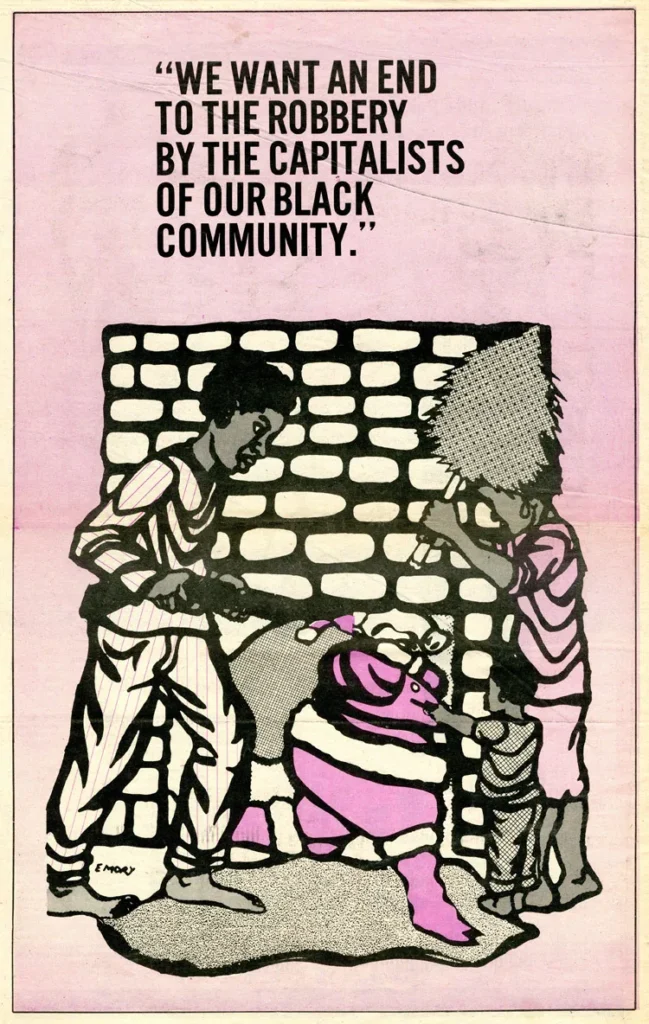
Emory Douglas signed this piece “EMORY” down in the corner, and the words across the top are point three of the Black Panther Party’s Ten-Point Program: “We want an end to the robbery by the capitalists of our Black community.”
The full version of that demand, written in October 1966, asked for “the overdue debt of forty acres and two mules,” promised 100 years earlier as restitution for slavery, and said the Panthers would accept payment in currency. Douglas’s job was to turn demands like that into pictures people could read at a glance on a street corner.


He learned the trade in juvenile detention. Douglas was locked up at the Youth Training School in Ontario, California, where he worked in a print shop that made product labels for businesses. The supervisor showed him how to design the labels himself, and he later said it was his first experience with graphic production. After his release he studied commercial art at City College of San Francisco.
In early 1967 he met Huey Newton and Bobby Seale and offered to help with their newspaper. The first issue of The Black Panther was a plain sheet Seale had put together. Douglas designed every issue after it until the paper stopped in the early 1980s, as the party’s Revolutionary Artist and later its Minister of Culture. The government noticed. According to a congressional report cited by AIGA, the FBI’s sabotage included spraying the paper’s production equipment with a synthetic fecal scent and destroying shipments of newspapers carrying his art.
Comments